

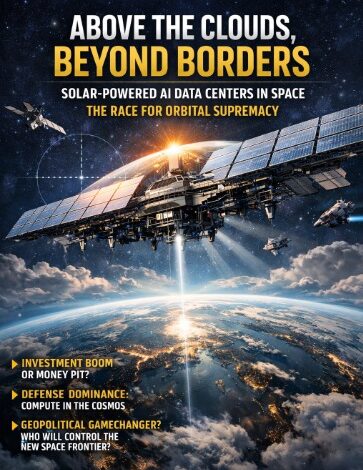
Solar-Powered AI Data Centres in Space: Vision, Power and the New Geopolitics of Compute
By Sulabh Shukla
By the time oil defined global power, nations fought over land.
By the time data defined economies, they fought over servers.
Now, as AI defines the future, the next question is simple: will power move to the space?
The Big Idea: Taking AI Infrastructure Off the Planet
As artificial intelligence consumes unprecedented amounts of energy, land, and political capital, a radical idea is gaining quiet momentum in policy circles, defence think tanks, and venture capital decks:
What if the future of AI data centres is not on Earth at all—but in space?
Picture massive orbital platforms, powered by uninterrupted solar energy, processing exabytes of data, training sovereign AI models, and relaying intelligence back to Earth at the speed of light. Free from land acquisition battles, environmental protests, and national grid constraints, these space-based AI hubs promise something irresistible to governments and investors alike: limitless compute, strategic autonomy, and geopolitical leverage.
It sounds futuristic. It also sounds inevitable.
But between ambition and execution lies a harsh reality shaped by physics, economics, and power politics.
The Investment Lens: A Trillion-Dollar Dream—or a Capital Sink?
From an investment standpoint, space-based AI data centres represent the most extreme form of infrastructure capital.
Why Investors Are Interested
- Exploding AI compute demand is outpacing Earth’s energy and cooling capacity.
- Hyperscalers are facing land shortages, power bottlenecks, and community resistance.
- Space offers a theoretical solution: constant solar power, no real estate limits, and long-term strategic value.
For long-horizon investors—sovereign wealth funds, defence-linked capital, and deep-tech VCs—space AI infrastructure resembles early oil exploration or undersea cables: high-risk, high-control, long payoff.
Why Capital Is Cautious?
- Launch and assembly costs remain astronomically high.
- Maintenance and upgrades are complex and risky.
- Returns are unclear outside specialised use cases.
In pure ROI terms, Earth-based DataCentres still win decisively. Space AI is not a hyperscale play—it is a state-backed, strategic capital play.
The Defence Angle: Compute as the New High Ground
Militaries have always sought the high ground. In the AI age, compute is the high ground.
Strategic Advantages
- Space-based AI systems can process satellite imagery, missile tracking, cyber intelligence, and autonomous systems without reliance on ground infrastructure.
- They are less vulnerable to terrestrial sabotage, power outages, or civil disruptions.
- In conflict scenarios, orbital AI offers resilient, autonomous decision-making capability.
This is why defence agencies view space AI data centres not as cloud infrastructure, but as strategic assets—akin to aircraft carriers or early-warning systems.
The Arms Race Risk
If one nation deploys AI compute infrastructure in orbit, others will follow. This raises urgent questions:
- Who controls orbital AI?
- What constitutes an attack on space-based compute?
- Does disabling an AI data centre in orbit count as an act of war?
Space, once a shared domain, is quietly becoming the next AI battlefield.
The Geopolitics: Sovereignty Beyond Borders
Perhaps the most disruptive aspect of space-based AI data centres is their impact on sovereignty.
On Earth, data centres are governed by:
- National laws
- Tax regimes
- Environmental regulations
- Political pressure
In space, governance is ambiguous.
Why Nations Are Paying Attention
- Orbital AI infrastructure could operate beyond traditional jurisdiction.
- It allows nations to bypass sanctions, chokepoints, and energy dependencies.
- Control over space compute could reshape global digital power balances.
For emerging powers, this represents a chance to leapfrog terrestrial constraints. For established powers, it is about preventing loss of dominance.
The result: a silent but accelerating competition to define the rules of AI beyond Earth.
The Reality Check: Space Is Not a Data Centre-Friendly Place
Despite the strategic allure, reality intrudes forcefully.
Cooling Is a Major Challenge
Space is cold—but it cannot absorb heat easily. AI servers generate immense thermal loads that require massive radiators, making cooling harder, not easier, than on Earth.
Energy Is Not Infinite
Solar power in orbit is continuous, but not limitless. AI training requires power at city-scale levels, demanding enormous panel arrays and energy storage systems.
Radiation Is Relentless
Cosmic radiation damages advanced chips. Radiation-hardened processors exist, but they lag far behind the performance required for modern AI models.
Latency Still Matters
For real-time AI—finance, healthcare, consumer services—milliseconds matter. Orbital compute cannot replace edge and ground-based systems for most applications.
Where Space AI Will Work
The future of space-based AI data centres is not general-purpose cloud—but strategic, specialised compute.
They make sense for:
- Defence and intelligence processing
- Earth observation and climate modelling
- Autonomous satellite networks
- Deep-space missions and exploration
- Strategic redundancy in case of terrestrial failure
In these domains, processing data where it is generated offers clear advantages.
Earth Remains the AI Factory—For Now
For the next two decades, the AI infrastructure race will remain grounded:
- Cold-climate terrestrial data centres
- Renewable-powered grids
- Advanced liquid and immersion cooling
- Energy-efficient AI architectures
Earth is still cheaper, faster, and easier to scale.
Space is not the replacement—it is the insurance policy.
Final Word: The New Power Equation
Solar-powered AI data centres in space are not science fiction. They are strategic infrastructure in waiting—too expensive for markets alone, too powerful for governments to ignore.
They represent a future where:
- Compute equals sovereignty
- Energy equals influence
- Orbit equals power
The race for AI supremacy may not be won in data halls or server farms—but in silence, above the atmosphere, where sunlight never sets and borders do not exist.
The question is no longer if AI infrastructure will move to space.
It is who will get there first—and who will set the rules when it does.