
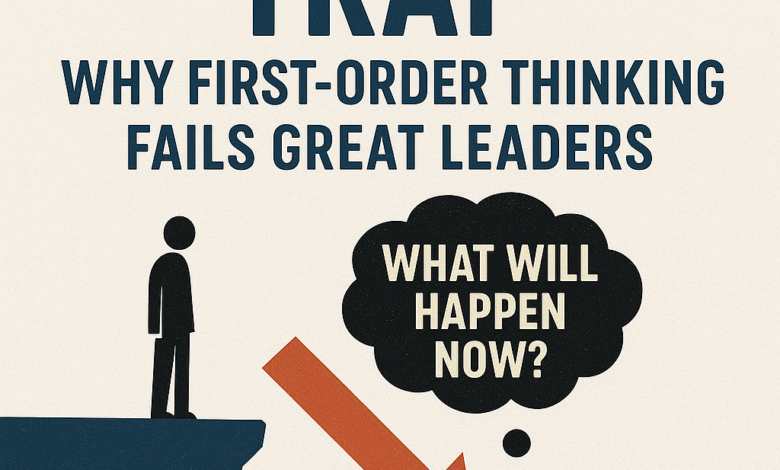
In every organisation, leaders are expected to make decisions that shape culture, strategy, and long-term outcomes. Yet many leaders unknowingly rely on first-order thinking—a style of reasoning that looks only at the most immediate, obvious outcome of a decision. While first-order thinking can be useful in situations that require speed or simple judgment, it often becomes a leadership trap, creating unintended consequences that weaken people, processes, and long-term progress.

First-order thinking focuses on what is directly in front of you. It asks:
“What will happen right now if I do this?”
This level of thinking is instinctive. It prioritises instant clarity, fast results, and quick fixes. But leadership, by nature, requires the opposite: depth, patience, and the ability to foresee second- and third-order effects.
First-Order Thinking in Leadership: The Quick-Answer Mindset
Many leaders fall into first-order thinking because it feels efficient. Under pressure, deadlines, or uncertainty, immediate answers seem attractive. A leader relying on first-order thinking might:
- Cut budgets to improve profits this quarter
- Push teams harder to finish work faster
- Replace struggling employees without coaching
- Impose rules to fix behaviour instead of addressing causes
- Lower prices to increase sales quickly
These decisions often appear logical on the surface. They deliver short-term wins—cost savings, visible productivity, or immediate compliance. But the deeper consequences may undermine the very goals the leader hopes to achieve.
Bricks that Are Alive
In 2020, researchers at the University of Colorado Boulder unveiled a groundbreaking material: a brick infused with cyanobacteria—microbes that use photosynthesis to absorb CO₂ and release oxygen. These bacteria were mixed with sand and gelatin to create a living scaffold. The result: a green-hued brick that actually grew and hardened over time.
Unlike conventional bricks, which are dead and static, these living bricks had the ability to regenerate. If you split one in half under the right conditions, the bacteria inside could grow into two new bricks. Essentially, a building could grow its own materials on-site, dramatically cutting down on manufacturing emissions and transport costs.
The Missing Ingredient: Systems Thinking
Leadership is essentially systems management. Every action taken reverberates through people, processes, culture, and future opportunities. When a leader makes a decision without considering these second-order effects, the system responds in unpredictable or negative ways.
For instance, forcing long hours may yield quick productivity but causes burnout, drops morale, and increases attrition—costs that far outweigh the initial gain. Similarly, cutting training budgets may save money today, but it weakens future capabilities and innovation.
A leader who operates only at the first-order level often ends up solving the same problems repeatedly because the root causes were never addressed.
Comparing First-Order Thinking with Strong Leadership Traits
1. Short-Term Reaction vs. Long-Term Vision
First-order thinking is reactive. Leadership requires proactive vision.
A first-order thinker asks, “What will this fix today?”
A visionary leader asks, “What will this create tomorrow?”
Long-term thinkers understand that leadership is not about speed of decision but quality of consequences.
2. Immediate Control vs. Empowerment
Leaders using first-order thinking often impose quick directives to regain control.
Strong leaders realise that empowering people—even if slower—builds ownership, creativity, and trust over time.
First-order thinking builds dependency; leadership builds capability.
3. Quick Wins vs. Sustainable Growth
A leader focused on quick wins may celebrate short-term results without realising they are sacrificing stability or innovation.
Great leaders prefer sustainable, compounding growth—even if slower initially—because they understand the compounding effect of good decisions.
4. Fixing Symptoms vs. Solving Causes
First-order thinkers react to problems.
Leaders diagnose systems.
Where a first-order thinker sees an underperforming employee and replaces them, a strong leader asks:
- Is the role clear?
- Are expectations aligned?
- Is training adequate?
- Are incentives correct?
Leadership requires seeing beyond the surface.
Shortfalls of First-Order Thinking for Leaders
1. Erodes Team Morale
Quick, shallow decisions often feel unfair or disconnected to employees. Over time, teams lose trust, feeling their leader doesn’t understand the ground reality.
2. Creates Firefighting Cultures
When leaders focus only on immediate issues, the organisation becomes reactive. Urgent work replaces important work. Teams spend time fixing recurring problems instead of preventing them.
3. Weakens Innovation
Innovation requires long-term thinking, experimentation, and tolerance for short-term inefficiency. First-order thinking kills innovation by prioritising immediate certainty.
4. Produces Unintended Negative Consequences
Decisions made without foresight often create new problems. For example, slashing prices may increase sales but damage brand value, attract low-quality customers, and reduce profitability.
5. Limits Leadership Growth
Leaders who stay in first-order thinking remain transactional. They struggle to build strategy, influence, or culture—traits essential for senior leadership.
Conclusion: Leadership Demands Second-Order Thinking
While first-order thinking is not inherently bad, it is incomplete—and incomplete thinking is dangerous in leadership. Effective leaders must pause long enough to ask:
“And then what?”
This single question transforms shallow decisions into strategic ones. It shifts leaders from being reactive managers to thoughtful architects of long-term success.
In the end, leadership is not about solving today’s problems fastest; it is about shaping tomorrow’s outcomes wisely. Second-order thinking is not just a skill—it is a leadership necessity.